20090223

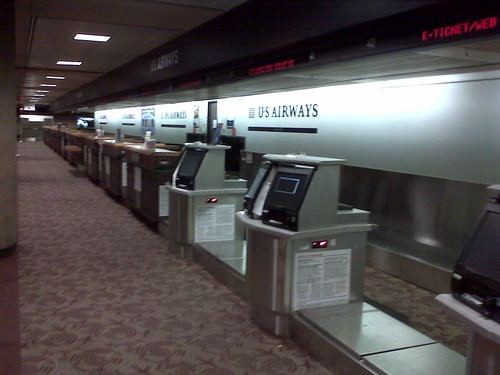
No one home...


No one home..., originally uploaded by rob-the-org.

I was leaving town last week on a business trip - and I had the first flight of the day. Too bad no one told the airline that they had a full load of passengers ready to go flying with them. TSA was ready to screen the bags - but they can't screen them until they get checked in.

[Standing around waiting for someone to check bags - is only obnoxious - when you arrive at the airport at 4am, and would rather have been sleeping longer instead of standing around waiting].

90 minutes before the flight - at least 6 staff members streamed out of the behind the scene's hideaway and proceeded to check everyone in and direct us up to the 'B' gates.

Where the security checkpoint - wasn't open yet. So it was time to walk to the other end of the Terminal to go through the 'A' security checkpoint. And then walk back to the 'B' gates (because the moving walkway inside of security was being replaced on the A -> B pathway).

Oh - and when I walked past the 'B' checkpoint - there was at least enough TSA staff to have a lane open.

I hope this trip gets better.....

20090215

Decisions, Decisions, Decisions

What's with the weekend of February 21st? It seems like there is no shortage of things to do all at once.
Why couldn't this all be spread out across a couple of weekends?

[UPDATE - 16-Feb] - I just need to stop looking for things on this coming weekend. I keep finding more;

20090123

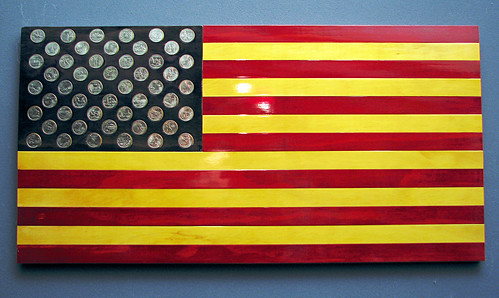
How to display your State Quarter collection


Red, Wood, and Blue, originally uploaded by Roger Smith.

I don't like how the program was extended to include the Territories for 2009.

At least DC got slapped down when they tried to put 'Taxation without Representation' on their design.

20081224

Fiber optic cable - the backbone of the Internet


fibre optic cable, originally uploaded by spore2002.

If you are looking for something to read when the holiday overdosing kids put you are the verge of a nervous breakdown - just find a warm browser and bring up the following article by Neal Stephenson (author of the Cryptonomicon) about the construction of the FLAG (Fiber Optic Link Around the Globe) cable.

Service through the FLAG cable was disrupted earlier this week - when what has been termed a 'seismic event' off of Malta.

Another section of this same cable network was cut in off Egypt back in January - probably by a ship's anchor.

20081216

Winter in the Desert - rainy season


Large waterdrops on glass, originally uploaded by rob-the-org.

Winter has finally arrived in the desert - which means rain isn't just a dream in the weatherman's eye. It started with just a sprinkle yesterday and has been a steady rain overnight.

I wonder how many overconfident SUV drivers will have to be pulled from their vehicles after driving through flooded washes.

But now I have bigger fish to fry - one of those overconfident SUV drivers has just rear ended my wife while she was driving to work.

Beautiful.

20081117

Roadside service for a Commercial Airliner

In the November 2008 issue of Air & Space (Smithsonian) Magazine had an interesting article on Boeing's Aircraft on Ground (AOG) team. The author was able to follow the team as they repaired a Boeing 767 that had been damaged when it had been backed into a jet blast fence and the rear pressure bulkhead had been punctured.

[Air & Space said that they were asked not to disclose whose airliner this was and what airport that this took place at]

Here's a picture from Boeing - showing the vertical stabilizer being put back on (contrary to the caption). If this was the only picture you saw - you wouldn't know that the caption was wrong. I'll explain how I can tell in a minute - the hint is in the lower left hand corner of the picture.

This past weekend on the National Geographic channel - their (HGC) series "World's Toughest Fixes" featured this specific 'fix'. NGC wasn't nearly as shy about saying where this was all taking place. It was in Paris, at Charles DeGaulle airport. The damage occurred on Chrismas Eve (2007).

If you can catch this episode either this week or in repeats - set the Tivo/DVR for it. Its interesting to see what goes into a job like this. If you don't get NatGeo or don't have the time for it - click here - for a quick 2 minute summary of the repair.

Ok - so back to that first picture. The lower left hand corner is a video camera (filming the NGC episode), and the green section of the underside of the fuselage is what gives this picture away as being post-repair. That green section of the fuselage is the section of skin that was replaced as part of the repair.

Also - look at this picture - showing the pressure bulkhead being replaced - the guy on the right in the red hat is the host of "World's Toughest Fixes." You can pick him out because he is the only one with chest pouch/toolkit.

Finally - to answer the question 'whose airliner was this' - I present links to two pictures;
It actually wasn't too hard to find pictures matching this airline livery on-line. The TV show helped somewhat - when they had a close up of the vertical stablizer being put into its temp cradle - you could see what looked like two white birds in flight (in between the red and green fields).

BTW - the airline really wanted to get the plane back in the air. They only have two 767's in service. So while this one was laid up for 3 weeks - they long range fleet was at 1/2 capacity.

20081116

How to - make your own QR Code

[if you watch CSI:NY on CBS, the episode last week featured QR codes on the back of the 'tell all' stationary that was part of the murder investigation]

I have already shown how you can decode a QR code - and now you want to create a QR code of your own. Start by going to the Google Chart API developers guide. In addition to the standard line charts, bar charts, pie charts, Venn diagrams and maps - the Google Chart API also supports QR codes.

You call the API just as you would call any other image that you would link to;

http://chart.apis.google.com/chart?cht=qr&chl=URL:http://www.strongholddigitalservices.com&choe=utf-8&chs=200x200&chld=Q|10
  • Chart AP - http://chart.apis.google.com/chart?
  • Chart type - cht=qr
  • Data to encode - chl=URL:http://www.strongholddigitalservices.com
  • Encoding - choe=utf-8
  • Size (in pixels) - chs=200x200
  • Error correction | margin - chld=H|5
Note - the amount of data will determine how many bits are in the QR code. The size just determines how big the output will be.

The Error correction letter says defines how much of the QR code can be missing or obscured, while still allowing the data to be retrieved. The 'H' code allows up to 30% of the image to be missing or obscured, and still able to maintain the data.

Here are some samples to illustrate the differences.

Size 200x200, Error Correction = H


Size 100x100, Error Correction = H


Size 200x200, Error Correction = L (worst, only 7% error/missing/obscure)

All three images contain the exact same data - but they differ only in size (between 1st and 2nd) and data correction (1st and 3rd).

Now - why has Google gone to such trouble to include the QR code in their Chart library? I don't know for sure - but it happens to be part of their Android mobile phone OS on TMobile's G1 handset. Beyond that - we will have to see if these start showing up and get adopted by more than just the twenty-something's.